20100831

Pop go the people


Imagine that your loved one suddenly disappeared and you have not seen or heard from him or her ever since. I believe the feelings of uncertainty, worry, agony and helplessness can be even worse than if that person is confirmed dead.

People don't just disappear without a reason. Except in the rather rare instances that the disappearance is self-induced, such as when the person has to flee from someone or something, most cases of disappearance involve the subjects being abducted. In such cases, the ones who suffer are not only the disappeared, who are under grave danger of being harmed, tortured or killed, but also their families. And that is what makes the International Day of the Disappeared, which took place yesterday, very meaningful.

Here is what Amnesty International USA says about "enforced disappearance":

"You could be taken at any time, day or night. You might be at home, at work or traveling on the street. Your captors may be in uniform or civilian clothes. They forcibly take you away, giving no reason, producing no warrant. Your relatives desperately try to find you, going from one police station or army camp to the next. The officials deny having arrested you or knowing anything about your whereabouts or fate. You have become a victim of enforced disappearance.

"Enforced disappearance is a grave human rights violation and a crime. Amnesty International defines an enforced disappearance as the detention of someone by the state or its agents, when the authorities deny that the victim is in custody or conceal what has happened to them. Enforced disappearances have occurred across the world - in Sri Lanka, Russia, El Salvador, Morocco, Iraq, Thailand, Pakistan, Bosnia, Equatorial Guinea, Egypt and Argentina, to name a few. No one is immune; victims have included men, women and children.

"An enforced disappearance violates the rights of both the disappeared person and their relatives. Disappeared persons are denied the right to a proper arrest and to a fair trial. They may be tortured, detained in poor conditions and eventually killed. The relatives of the disappeared persons suffer anguish every day, not knowing what has happened to their loved one; they are victims, too. They often encounter social isolation, with relatives and neighbors being too afraid to offer aid or support. If the disappeared person was the main breadwinner for the family, they can also suffer economic hardship."

While these paragraphs talk about disappearance enforced by countries, typically the totallitarian ones or ones where the rule of the law is not respected, there are also cases where people, usually helpless ones such as children or young women, are abducted or enticed. In the film Slumdog Millionnaire, for example, a cold-blooded man lured the children living in the slum in Mumbai with bottles of coke, then made them blind and forced them to beg for him. Similar stories are often heard from across the border of Hong Kong.

Do not think that just because you happen to live in a democratic or relatively safe country, such a thing will not happen to you or someone you hold dear. Here in Hong Kong, once in a while there are high profile news story about some girls or children suddenly evaporating.

Should such an unfortunate thing happen to your dear one, a website like www.personsmissing.org, which provides information and a registration service, should offer some hope and help.

20100830

The problem does not lie with the journalist

In his book The Black Swan, Nassim Nicholas Taleb talks about how media journalists like to propose a cause for news items to make matters more concrete. After describing the phenomenon he says:

"The problem of overcausation does not lie with the journalist, but with the public. Nobody would pay one dollar to buy a series of abstract stastics reminiscent of a boring college lecture. We want to be told stories..."

I would like to argue that we can take the structure of these sentences and apply them to aspects of the media that we are so critical about, such as sensationalism, editorial bias, and they will make perfect sense. Just try:

"The problem of [put down what you don't like about the media here] does not lie with the journalist, but with the public. Nobody would pay a dollar to.... We want to be ...."

The truth cannot be more obvious. We, the media consumers, are the problem. The media are just feeding us with what we are wailing for.

Much as we believe we are helpless against yellow journalism, the day we all refuse to pay that one dollar, everything will be cleaned up.

20100829

No newspaper is good newspaper

My media consumption has become more and more sparing and selective in recent years. Take newspapers for an example. Until a few years ago, every Sunday I used to return home from the church with a Chinese newspaper. Not that any of the local papers was ever worthy of anyone's time, but I found leafing through the only non-compliant paper in Hong Kong a leisurely way to spend a Sunday morning. But as I became increasingly disgusted with and disillusioned by the hypocrisy and consumerism, I felt that having to pay a few dollars and sacrifice a few trees for information of such ludicrously poor quality an insult. I turned to reading the same paper online for a while, but even that has now ceased to be a habit.

But I do browse sometimes, to look for something just to sneer about. There is no disappointment or anger because the expectation has long gone.

In the last few days, what I paid attention to was the frontpage headlines following the shooting incident in Manila. One can find, in mega-text, something like "MOST PAINFUL", "COME HOME - FEEL THE LOVE OF HONG KONG", "PULL YOURSELF TOGETHER JASON", "HONG KONG HAS AN IRON MOTHER" and "EVIL POLICEMAN". I don't know how many people see these as words of compassion and encouragement, but I certain think they are perfect examples of cheap sensationalism, reflecting an attempt to profiteer from a most unfortunate incident.

These may not be as bad as the frantic scramble in 2008 to publish the obscene photos of some Hong Kong female stars that had been uploaded to the Internet, but the ultimate purpose remains the same - to sell more copies.

20100828

Hokkaido photos (2)

These pictures were taken in Kurodake:


20100827

Hokkaido photos (1)

The photos taken in Hokkaido have been organised.

Here are three taken at Asahiyama Zoo:


20100826

Big Ear vs Jarhead

In the Hong Kong film Echoes of the Rainbow, which won the Crystal Bear award in the Generation category at the Berlin Film Festival this year, the eight-year-old boy Big Ears was portrayed as always running around with a fish tank in his head.

In a recent piece of news, a six-month-old black bear cub was seen to cut a similar figure. But it was nothing hilarious at all.

"Jarhead", as the cub was affectionately dubbed", and its mother and two siblings were regular visitors to rubbish containers near Weirsdale in the Ocala National Forest in Florida. In late July this year, a local resident saw him running around with a clear plastic jar stuck in its head. The jar made it impossible for the cub to eat and drink. The concerned resident called the Florida Fish and Wildlife Conservation Commission, which then developed a plan to capture Jarhead. They knew that the cub would die if the jar was not removed. The team of rescuers set traps in different areas, hoping to catch and tranquilise the mother, which would then allow them to catch the cubs.

After ten days without success, in the last two of which there was no more sighting, the team feared the cub might have died. But when they were about to pull the traps and give up, a fresh sighting was reported. So they rushed back, shot the mother with a tranquiliser dart and then subdued the cubs. The family was later released in a less populated area nearby.
While the story ended happily, it raised concerns about issues related to wild animals scavenging in human neighbourhood.

20100825

Ready for the black swan

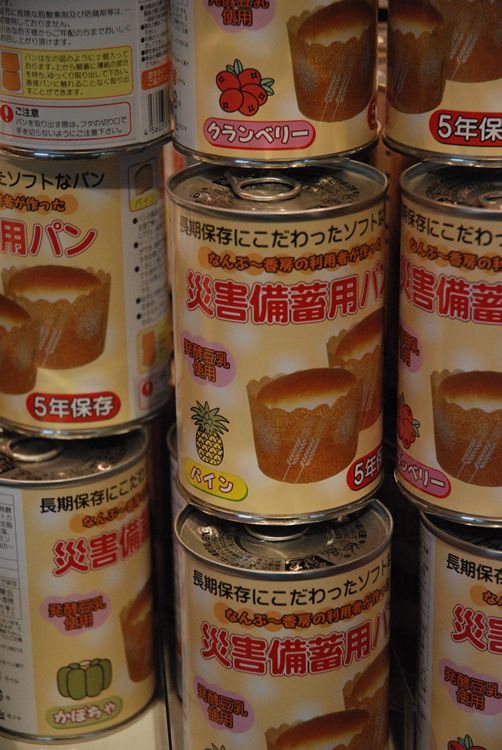
This picture of some canned food on the shelf, which I took in a supermarket in Furano, shows how well prepared the Japanese are about things.

The pictures on the cans suggest that the content is fruitcake. The label says that the food is for storage in case of disasters. The food can be preserved for a long time, up to five years.
That means some Japanese people stock a number of cans of this food at home and have them replace every five years, just to prepare for the worst.

They take no chances and are always ready for the Black Swan, to use Nassim Nicholas Taleb's famous analogy.