Showing posts with label language. Show all posts

20110416

lshccomnaiweda... What?


"OMG! LOL's in the OED. LMAO!"

I have no idea whether the expression above shows how the English language is going to be like in the (not-so-distant) future, but there are signs that such "Net Speak", has not only infiltrated into daily usage but also been inducted into the canon of the English language. Increasingly, in the work emails (not so many years ago, my supervisor at work maintained that one should say "email messages" rather than "emails" as "email" should not be taken as a countable noun) written by my colleagues, I see more and more occurrences of BTW, Thx, etc. I haven't seen any LOL (meaning "laugh out loud") yet, but the fact that the Internet slang term is, as the opening sentence says, in the Oxford English Dictionary, means that linguists have acknowledged its place in the language. As Graeme Diamond, the OED's principal editor for new words says, love it or loathe it, it is now a legitimate word in our lexicon.

While such initialism has become the trend, some slang abbreviations may have gone a bit too far, such as "lshccomnaiweda", which means "laughing so hard coke came out my nose and i wasn't even drinking any". Language purists understandably regard the situation as a literacy crisis, while the liberals see it as enriching the language and such "code switching" by children as beneficial. Like it or not, as Diamond says, "language is a vibrant, evolving animal". It is bound to change according to popular usage.

20110407

Death of English


The dwindling position of English in Hong Kong society after the changeover of sovereignty is evident in the difficulty in the vastly reduced number of cinemas showing animation films in English.

Ever since I was a child, I have avoided films with Cantonese voiceover, treating the poor quality and lack of creativity with contempt. Cartoons and animation films are especially bad as the twisted voices of adults impersonating children are simply hair-raising.

It didn't use to be a problem as there were many cinemas showing the films in English version. But that is not the case anymore. Like the movie Gnomeo and Juliet that I am interested in seeing, in one chain of cinemas, only one out of seven cinemas show the English version, and that is the one which is on Lantau Island, the one which is furthest away from the city centre.

It is understandable that businesses provide commodities and services that are the most popular so that they may maximise their profit. Obviously, in today's Hong Kong, there is a much larger market in Cantonese films. Truth to speak, English has never had a role to play in the average Hong Kong people's daily life. Now it is as marginalised as ever.

20110406

"Guesi House"


Unfortunately, English errors in other countries, such as the one shown above which is uploaded onto the Internet as a joke, are increasingly common in Hong Kong. The huge sign which says "Dinning" and the stick saying "Please singe and return to me" that I wrote about on 25 and 30 November last year were two examples.

The photo below, taken on a Hong Kong street by an Australian friend of mine, is another example. I wonder if the fact that the error is in the sign with simplified Chinese characters (the version used in the Mainland) but not the one with traditional Chinese characters (the version used in Hong Kong) can be used as an excuse.

20110405

An International City?


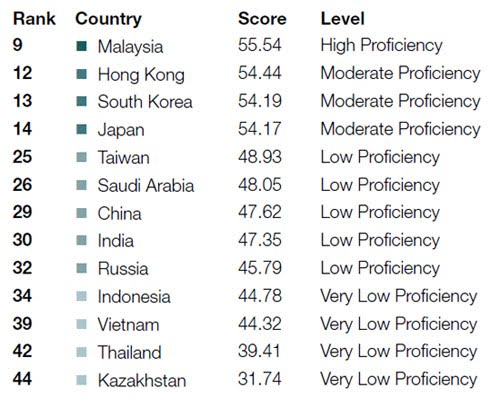
A recent report on the English proficiency of countries where English is not the mother tongue confirms a fact that should leave Hong Kong with no illusion.

According to the English Proficiency Index 2011 report released by Education First on 30 March, Malaysis is most proficient in English in Asia. In fact, it is the only Asian country given the "high proficiency" rating (out of the index's five levels of "very high proficiency", "high proficiency", "moderate proficiency", "low proficiency" and "very low proficiency"). Hong Kong, South Korea and Japan lag behind, ranked second, third and fourth in Asia respectively, and are all given the "moderate proficiency" rating. While Hong Kong is ranked above South Korea and Japan, the scores of the three places, at 54.44, 54.19 and 54.17 respectively, are really close. And if the fact that English is an official language of Hong Kong but not South Korea and Japan is factored in, Hong Kong's lead is even more shaky and questionable.

Given that English is an international language for communication, a report like this should serve to dispel any myth or hallucination that Hong Kong is an international city.

20101208

"Whatever" you say


How does a statement like this make you feel?

"Whatever you think about using grating words, at the end of the day it's actually better not to say whatever, if you know what I mean."

You should be somewhat pissed off, if the Marist poll on the most annoying word or phrase in the English language is anything to go by. "Whatever" tops the list, followed by "like", "you know what I mean", "to tell you the truth" and "actually".

What makes these words or phrases so irritating? If you look at these top five, you will notice that they are either dismissive, patronising or condescending.

How about the Chinese language? It will be interesting to have a poll like that. My personal picks of annoying words and phrases are context specific. When financial analysts on TV say "in terms of" in every other sentence to sound more professional, when salespersons in shops harrass you by saying "can I help you?", when cold callers reveal their identity by saying "how are you, sir?", it drives me mad.